An excellent question posted by Fern of Life on the Balcony, a fun blog which shares her adventures in container gardening:
Why is it better to transplant a plant into a series of progressively larger pots? I’ve seen that recommended in books, but they never say why it’s better than a small plant potted in a big pot (other than the obvious point that a tiny plant in a huge pot would look ridiculous).
Garden experts tell us that when we’re transplanting shrubs and trees into larger pots, we should transplant them into a slightly larger container rather than a much larger one. So if you want to get a Japanese Maple with an 18″ rootball into a 24″ pot, it’s best to transplant it once into a 21″ pot, and after it’s filled in, move it up to the 24″ pot.
But why is that? The simplest way of explaining it is that if the pot is too large, the ratio of plant roots to soil will be too great for the roots to absorb all the moisture after watering, which leads to water sitting at the bottom of the pot and causes the roots to rot.
Even after learning about that in Hort school, I still wondered, “well, why wouldn’t the extra water just drain out?” But the issue is one of surface tension and the fact that your potting mix is meant to hold water – because of those two factors, for which we are quite grateful on hot summer days, not all the water can drain out. If your plant can’t drink it up quickly, the pot becomes a haven for bacteria and fungus.
Now, how do you use this info in planting your containers?
Plants’ roots grow at different speeds, so for the following rules of thumb, take into account whether you have a vigorous grower which will quickly outgrow its space, or a slow grower which may only grow a few inches per year, like many dwarf conifers.
If you are transplanting into a:
12” pot with a slow growing plant, you can leave 1” all the way around the existing rootball to fill with fresh potting soil. For a fast grower, 1.5”.
18” pot with a slow growing plant, you can have 1.5” of soil on every side of the rootball. Fast growers can have 2”.
24” pot with a slow grower, 2” – fast growers, 3”.
30” pot with a slow grower, 2.5” – fast growers, 4”.
For transplanting an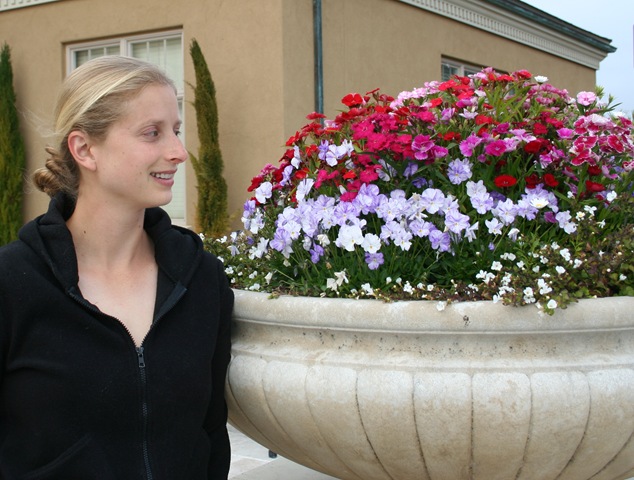 nuals into pots, I like to either use them in concert with a perennial or small shrub that will help fill out the root space, or plant them in a wider, shallower pot than is the norm. Using a shallow pot or wide planting basin can look more in scale with the ultimate height of most annuals, too, so they aren’t overwhelmed visually by a very tall pot.
8 responses to “Garden Q&A; Why Transplant Into Larger Pots in Stages?”
Thanks Gen!!! Great post!
Fern’s last blog post..Another Frugal Gardening Tip
[…] Almost any plant can be grown in a container, you just need to match the right sized container to your plant’s needs. However, don’t plant perennials in containers that are too big for them, it could cause their roots to rot. […]
[…] A tall narrow pot will probably look best with a plant that is also tall and bushy. A small, rounded plant will likely look silly in such a pot, like a scoop of ice cream on a cone. Other small plants are likely to look out of proportion to the pot. It’s also not good for a plant’s health to grow it in a pot that is too big for it. […]
[…] my peach tree. It is in a really tall pot that has more dirt that the tree currently needs. As Gen of North Coast Gardening has explained, pots that are larger than the plant needs have more moisture in the dirt than the […]
Thanks so much for visiting our blog – and thanks for sharing your tips. I read your post with great interest indeed! Nice to have the sense of mystery removed from this topic – mystery is better felt when contemplating the universe – or a grain of sand :0)
Thanks for this post. I completely understand this and am still resistant! (grin) The issue is how often I will now be required to do repotting. I feel as if this means I’ll spend the rest of my life simply moving all the plants up a notch every couple of months. I am rarely caught up on tasks as it is – how often do you actually wind up repotting?
And, don’t the California native plants get irritated by all this root disturbance?
Always looking for easy answers in spite of the facts…
[…] Almost any plant can be grown in a container, you just need to match the right sized container to your plant’s needs. However, don’t plant perennials in containers that are too big for them, it could cause their roots to rot. […]
I have an 18″ x 4′ pot that I’d like to plant on my full/most sun western facing patio. What is a good choice? I also have the same style (12″ x 3′)